
Roadmap
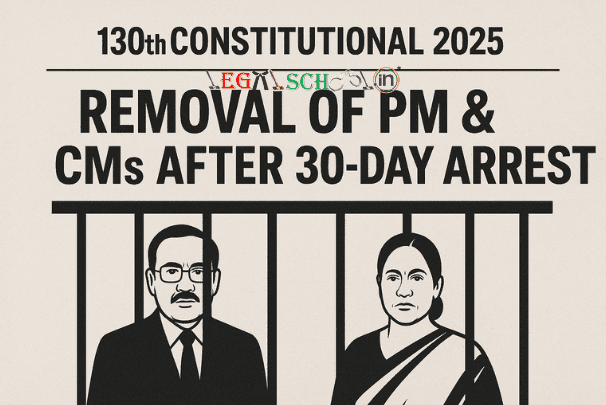
ToggleWhat Is the 130th Constitutional Amendment?
- Official Title: Constitution (One Hundred and Thirtieth Amendment) Bill, 2025
- Introduced by: Union Home Minister Amit Shah in the Lok Sabha on 20 August 2025.
Key Provisions: 130th Constitutional Amendment Bill 2025 and Its Political Impact
- Trigger for Removal: Applies if a Prime Minister, Chief Minister, or other Minister is arrested and detained for 30 consecutive days on charges involving offences punishable by five years or more imprisonment, without requiring a conviction.
- Constitutional Impact:
- Article 75 (Union Council of Ministers): The President removes a Union Minister (including PM) who fails to resign by the 31st day following 30 days of detention.
- Article 164 (State Ministers): The Governor removes the CM or state minister similarly, or the office is vacated automatically if no advice is given by the CM by the deadline.
- Article 239AA (Delhi NCT): Same rules apply to Delhi’s ministers.
- Possible Reappointment: The minister may be reappointed after release from custody.
- Legislative Process: After introduction, the Bill has been referred to a Joint Parliamentary Committee for detailed scrutiny.
Supporters’ Perspective
- Accountability and Governance: Advocates argue it prevents individuals facing serious criminal charges from retaining executive power and protects public trust.
- Political Support: Strategist Prashant Kishor supported the measure, stating it prevents governance “from jail” and addresses gaps in current laws.
Opposition & Concerns: Removal of PM & CMs After 30-Day Arrest
The Bill has triggered fierce criticism across the political spectrum:
- Mamata Banerjee (West Bengal CM) dubbed it a “super-Emergency,” condemning it as a “Hitlerian assault” on democracy and a threat to federal structure.
- Asaduddin Owaisi (AIMIM) argued it undermines separation of powers, enables executive agencies to act as “judge, jury and executioner,” and sets a dangerous precedent against the principle in criminal justice — presumption of innocence.
- M. K. Stalin (Tamil Nadu CM) called it a “black bill” turning India into dictatorship, contending that a mere 30-day arrest should not lead to automatic removal without conviction.
- CPI(ML) voiced that the Bill is a “death knell” for federalism and democracy, pointing out asymmetric impact against non-BJP governments.
- Mayawati (BSP) warned of misuse by ruling parties and urged reconsideration to protect democratic values.
- Parliamentary Protest: The Bill’s introduction sparked chaos in Lok Sabha—TMC MPs tore copies of the Bill, prompting deployment of marshals and near physical confrontations, highlighting the intense opposition in Parliament.
Summary Table: 130th Constitutional Amendment 2025 Explained
| Aspect | Summary |
|---|---|
| Purpose | Removal of ministers after 30-day detention without conviction |
| Applies To | PM, CMs, Ministers at central/state/Delhi level |
| Constitutional Changes | Amendments to Articles 75, 164, 239AA |
| Process | Introduced in Aug 2025; referred to Joint Committee |
| Support Arguments | Accountability, anti-corruption |
| Criticisms | Violation of due process, federalism, separation of powers |
This amendment proposes a dramatic shift in India’s constitutional and political framework — aiming to hold leaders accountable but raising serious concerns about misuse, democratic erosion, and constitutional safeguards.