Roadmap
ToggleTribal Justice Conference India, HNLU, 2026
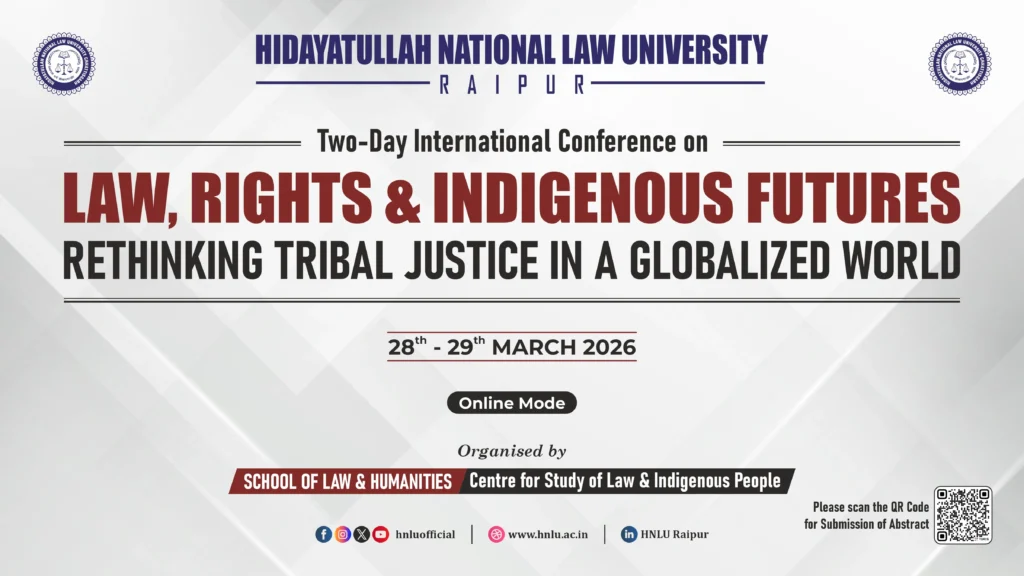
Hidayatullah National Law University (HNLU), Raipur is organising a Two-Day International Online Conference titled “Law, Rights, and Indigenous Futures: Rethinking Tribal Justice in a Globalised World”, scheduled for 28–29 March 2026.
This international academic conference aims to create a meaningful, interdisciplinary dialogue on Indigenous and tribal justice systems, human rights, development, and sustainability in a rapidly globalizing world.
About the Conference
Indigenous and tribal communities across the world are facing complex challenges such as:
- Displacement and loss of land
- Ecological and environmental degradation
- Cultural erasure and identity crises
- Political and legal marginalisation
At the same time, these communities possess:
- Deep-rooted customary laws
- Indigenous knowledge systems
- Community-based justice models
- Sustainable ecological practices
This conference seeks to bridge the gap between law, lived realities, and Indigenous futures by bringing together scholars, students, practitioners, policymakers, and community voices on one common platform.
Objectives of the Conference
The conference is designed to:
- Explore the meaning of justice for Indigenous and tribal communities in the context of globalization
- Promote interdisciplinary dialogue across law, social sciences, humanities, and environmental studies
- Centre student voices, youth perspectives, and first-generation scholars
- Encourage participation from tribal and Indigenous researchers
- Create long-term academic and policy impact through publication opportunities
- Foster global and comparative perspectives on Indigenous struggles
Key Themes and Sub-Themes
I. Law, Rights, and Justice
- Customary law vs. state legal systems
- Indigenous rights under international law (UNDRIP, ILO conventions)
- Restorative and community-based justice models
II. Culture, Identity, and Lived Experience
- Cultural resilience and language preservation
- Gender, intersectionality, and agency
- Oral traditions and Indigenous knowledge
- Media representation of tribal communities
III. Human Rights and Public Policy
- Health, education, and welfare in tribal regions
- Participatory governance and decentralisation
- Witch-hunting, displacement, and structural violence
IV. Climate, Ecology, and Sustainability
- Indigenous ecological knowledge
- Climate adaptation and environmental ethics
- Extractive industries and climate justice
V. Development, Economy, and Globalisation
- Development-induced displacement
- Mining, infrastructure, and corporate interventions
- Tribal economies and sustainable livelihoods
- Digitalisation and technology’s impact on Indigenous life
VI. Comparative and Global Dialogues
- Comparative Indigenous legal systems
- South–South perspectives (Asia, Africa, Latin America)
- Transnational Indigenous solidarity
Note: Submissions beyond these themes are welcome if they align with the conference’s core focus.
Important Dates
- Abstract Submission Deadline: 15 February 2026
- Acceptance Notification: 22 February 2026
- Registration Deadline: 7 March 2026
- Full Paper Submission: 15 March 2026
- Conference Dates: 28–29 March 2026
Types of Submissions Accepted
1. Research Papers (4000–6000 words)
- Original research with clear methodology and analysis
- Must include abstract (250–300 words)
- APA or Bluebook citation style
2. Policy Briefs (2000–3000 words)
- Evidence-based policy analysis
- Clear recommendations for policymakers
- Executive summary (150–200 words)
3. Community Case Studies (2500–4000 words)
- Grassroots experiences and community narratives
- Analytical reflection encouraged
- Abstract (150–200 words)
4. Ethnographic Notes (1500–2000 words)
- Based on fieldwork or participant observation
- Reflexive and descriptive approach
- Context note (100–150 words)
Submission Guidelines (Key Points)
- Format: MS Word only
- Font: Times New Roman, Size 12, Line spacing 1.5
- Include:
- Author name
- Institutional affiliation
- Email ID
- Contact number
- Short bio (100 words)
- Similarity limit: Maximum 10%
Publication Opportunities
- Selected papers may be published in an edited book with ISBN
- Blind peer-review process
- Separate publication fee applicable for selected papers
- Submission of copyright and declaration form mandatory
Who Can Participate?
- Law and social science students (UG & PG)
- Research scholars and young academics
- First-generation scholars and Indigenous students
- Legal professionals and interdisciplinary researchers
Registration Fees
- International Academicians: USD 30
- Indian Academicians/Professionals: INR 1000
- Research Scholars: INR 750
- Students: INR 500
- HNLU faculty and students: No fee
Panel Experts and Resource Persons
The conference will host:
- Eminent academicians and researchers
- Judges, lawyers, and legal practitioners
- Policy experts and think-tank members
- Indigenous leaders and grassroots activists
- Journalists, writers, and media professionals
- International scholars from multiple regions
Expected Outcomes and Impact
- Amplification of Indigenous and student voices
- Policy-relevant research outputs
- Interdisciplinary and global collaboration
- Capacity building for young researchers
About HNLU Raipur
Hidayatullah National Law University, Raipur, is a premier legal institution celebrating 20 years of excellence in legal education and research. Guided by its motto “धर्म संस्थापनार्थम्”, HNLU aims to nurture socially responsible legal professionals and scholars.
About the Centre for Study of Law and Indigenous People (CLIP)
CLIP is a dedicated research centre at HNLU focused on integrating Indigenous perspectives with legal scholarship. It promotes inclusive research, dialogue, and policy engagement on tribal and Indigenous issues.
Contact Details
📧 Email: conftrib@hnlu.ac.in
📞 Contact Number: 7587017829
![Human Resources Management (HRM) Online Certificate Course, 2026 by LRA [Live + Recorded]](https://www.legalschool.in/wp-content/uploads/2026/02/NEW-POSTERS-18-e1771894777597-1024x521.webp)