One Credit Certificate Course on Rural Governance, NLU Tripura
The National Law University, Tripura (NLUT) has announced a One Credit Certificate Course on “Rural Governance and Citizen Participation”, scheduled to be held in February 2026. Designed as an intensive 15-hour offline programme, the course focuses on grassroots governance, citizen engagement, and clinical legal education, offering law students and professionals hands-on exposure to rural democratic processes.
Established under the Tripura Act No. 3 of 2022, NLUT continues to strengthen its commitment to socially relevant legal education through this practice-oriented initiative.
About the Certificate Course on Rural Governance, 2026
The certificate course aims to bridge the gap between law, governance, and community participation, with a special emphasis on rural self-governance and constitutional empowerment.
Course Title
Rural Governance and Citizen Participation
Credit Structure
- One Credit Course
- 15 Hours in 5 Days (Extensive Learning Format)
Course Schedule & Key Details
| Particulars | Details |
|---|---|
| Dates | 13–17 February 2026 |
| Mode | Offline |
| Registration Fee | ₹750/- only |
| Last Date to Register | 12 February 2026 (05:00 PM) |
| Seats Available | Only 40 participants |
| Allotment Basis | First-Come, First-Served |
| Certification | Certificate on successful course completion |
Clinical Legal Education Focus
The course is structured around clinical legal education for grassroots governance, encouraging experiential learning through real-world engagement.
Core Learning Objectives
- Community-based and experiential legal education
- Legal aid, legal literacy, and empowerment of marginalised communities
- Strengthening citizen participation and democratic values
- Human-rights oriented and practice-based governance approach
- University–community engagement via legal clinics and outreach programmes
Course Highlights
Participants will gain in-depth understanding of the following themes:
- Constitutional foundations of rural self-governance (73rd Constitutional Amendment)
- Tripura Panchayats Act, 1993 and local governance in practice
- Three-tier Panchayati Raj System and institutional functioning
- Village Social Mapping: participatory governance tools
- Gram Panchayat Development Plan (GPDP) and citizen engagement
- Vikshit Bharat – GRAM G Act 2025 and rights-based rural employment framework
- National Food Security Act, 2013: food entitlement and delivery systems
- Mid-Day Meal Programme and the role of ASHA workers
- Right to Education Act, 2009: community participation and school governance
- Legal literacy, community empowerment, and access to justice at the grassroots
Course Faculty
Prof. Ajay Pandey
- Professor & Executive Director – Clinical Programmes
- Jindal Global Law School, O.P. Jindal Global University
- Fulbright Scholar (LL.M. in Clinical Legal Education), Vanderbilt University, USA
- Recipient of the Legal Education Innovation Award (2012)
His extensive experience in clinical legal education and community-based legal practice adds significant academic and practical value to the course.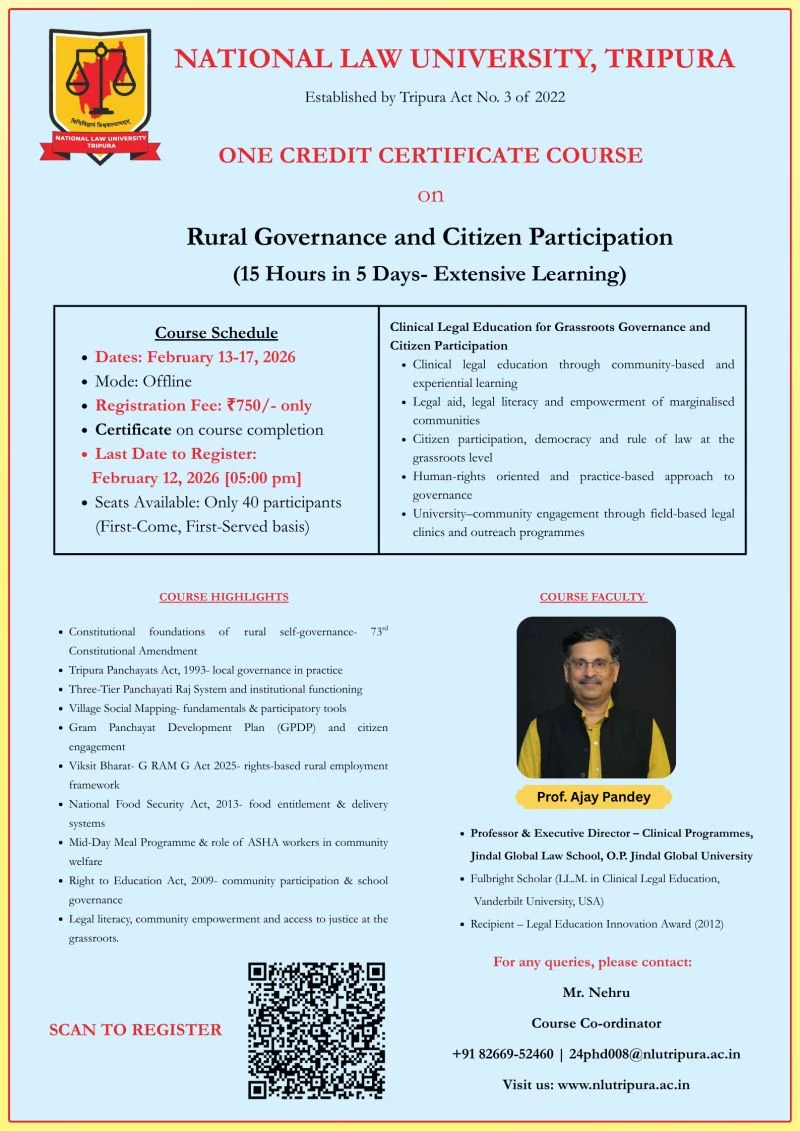
Who Should Enrol?
This course is ideal for:
- Law students
- Legal educators
- Social workers
- Policy researchers
- Individuals interested in rural governance, legal empowerment, and community engagement
Registration & Contact Details
How to Register
- Scan the QR code provided in the official brochure
- Limited seats available – early registration is strongly recommended
For Queries
Mr. Nehru
Course Co-ordinator
📞 +91 82669-52460
📧 24phd008@nlutripura.ac.in
🌐 Official Website: https://www.nlutripura.ac.in
Share this Post