
Roadmap
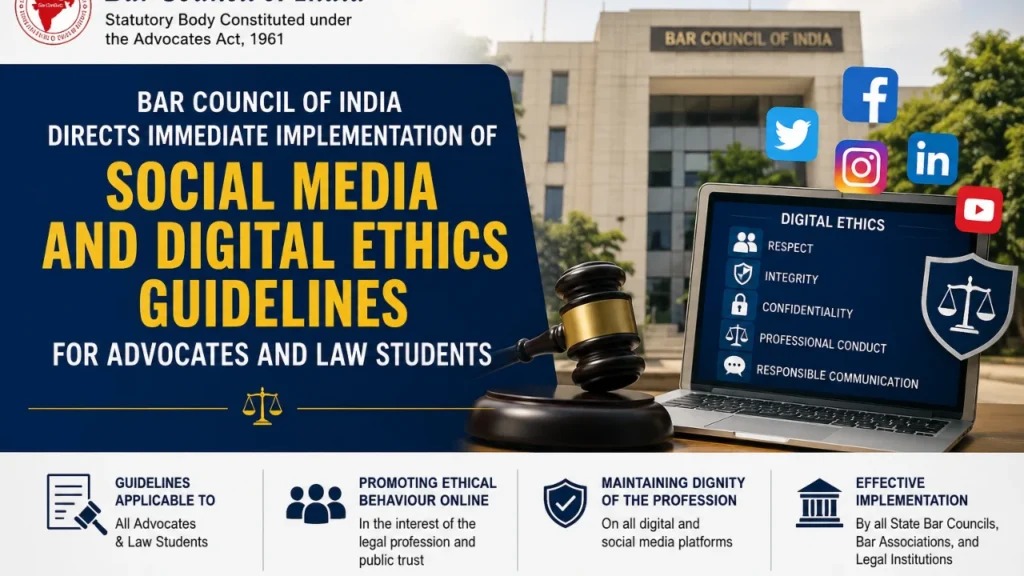
ToggleBar Council of India Directs Immediate Implementation of Social Media and Digital Ethics Guidelines for Advocates and Law Students
The Bar Council of India (BCI), through Circular No. BCI/D/4659/2026 dated 17 July 2026, has directed all State Bar Councils and Centres of Legal Education across India to immediately implement guidelines relating to social media conduct, digital ethics, court decorum, confidentiality, and professional responsibility.
The circular aims to strengthen ethical standards within the legal profession and ensure responsible use of digital platforms by advocates, law students, interns, faculty members, and legal institutions. It also addresses concerns related to misleading legal content, artificial intelligence-generated material, deepfakes, voice-cloned audio, and misuse of court-related information.
Key Objective of the BCI Circular
The primary purpose of the circular is to:
- Promote responsible and ethical use of social media.
- Protect the dignity and integrity of the legal profession.
- Prevent misuse of court proceedings and judicial content.
- Ensure confidentiality of client information.
- Regulate the use of artificial intelligence and synthetic digital content in legal communications.
- Create awareness regarding professional responsibilities among advocates and law students.
The Bar Council of India has clarified that the circular must not be treated as a routine communication and requires active implementation by all concerned institutions.
Directions Issued to Centres of Legal Education
All law universities, law colleges, legal education centres, and affiliated institutions have been directed to take immediate steps to ensure compliance.
Mandatory Actions for Law Colleges and Universities
Every Centre of Legal Education must:
- Circulate the circular among:
- Students
- Faculty members
- Research scholars
- Interns
- Internship coordinators
- Legal aid cell members
- Placement cell representatives
- Administrative staff
- Conduct awareness and orientation programs explaining:
- Social media ethics
- Professional conduct standards
- Consequences of violations
- Obtain separate undertakings:
- At the time of student admission
- Before commencement of every internship
- Include the guidelines within:
- Admission policies
- Internship rules
- Legal aid programs
- Moot court regulations
- Placement guidelines
- Institutional conduct policies
- Ensure students are properly briefed before being sent to:
- Courts
- Tribunals
- Advocate chambers
- Law firms
- Government legal offices
- Other internship organizations
- Appoint a Nodal Officer or Monitoring Committee for:
- Awareness initiatives
- Complaint handling
- Record maintenance
- Reporting requirements
- Maintain proper records of:
- Circular circulation
- Undertakings submitted
- Orientation sessions conducted
- Compliance measures adopted
Directions Issued to State Bar Councils
The BCI has also instructed all State Bar Councils to actively implement the circular among enrolled advocates and recognized Bar Associations.
Responsibilities of State Bar Councils
State Bar Councils must:
- Send the circular individually to every enrolled advocate.
- Circulate the circular to all recognized Bar Associations.
- Ensure Bar Associations:
- Display the circular on notice boards
- Publish it on official websites
- Share it through official communication channels
Additional Compliance Measures
State Bar Councils are required to:
- Mandate adoption of the circular by Bar Associations.
- Educate advocates regarding:
- Digital ethics
- Professional advertising restrictions
- Solicitation rules
- Confidentiality obligations
- Courtroom decorum
- Legal misinformation
- AI-generated content misuse
- Implement affidavits or compliance acknowledgements during future enrolment and regulatory procedures.
- Establish:
- Digital Ethics Committees
- Nodal Officers
- Complaint review mechanisms
- Create dedicated reporting systems such as:
- Complaint portals
- Official email addresses
- Online grievance mechanisms
- Collect and maintain compliance reports from Bar Associations.
Focus Areas Covered by the Circular
The circular specifically addresses concerns relating to:
Social Media Conduct
- Responsible online behavior by advocates and law students.
- Avoidance of content that may undermine professional dignity.
- Prevention of misleading legal representations.
Court Decorum
- Respect for judicial institutions and proceedings.
- Restrictions on unauthorized use of court-related material.
- Proper conduct within court premises and during legal proceedings.
Confidentiality Obligations
- Protection of client information.
- Responsible handling of chamber and office materials.
- Prevention of unauthorized disclosure of sensitive legal data.
Artificial Intelligence and Digital Content
Special emphasis has been placed on the misuse of:
- AI-generated legal content
- Deepfake videos
- Voice-cloned recordings
- Synthetic media
- Manipulated digital content
The BCI has highlighted the need for authenticity and accountability in all digital communications related to legal practice.
Compliance Must Be Meaningful and Verifiable
The Bar Council of India has clarified that:
- Simply uploading the circular on a website is not sufficient.
- Forwarding the circular through messaging groups alone does not amount to compliance.
- Institutions must adopt measurable and verifiable implementation mechanisms.
Authorities must maintain proper records and be prepared to produce them whenever required by the Bar Council of India or the respective State Bar Council.
Safeguards Against Misuse
The BCI has also emphasized that implementation of the circular must remain:
- Educational
- Preventive
- Fair
- Proportionate
- Consistent with legal principles
The circular should not be used for:
- Personal disputes
- Professional rivalries
- Moral policing
- Suppression of lawful criticism
- Action based on unverified allegations
All enforcement actions must comply with:
- The Advocates Act, 1961
- Bar Council of India Rules
- Applicable court regulations
- Principles of natural justice
About the Bar Council of India
The Bar Council of India (BCI) is the statutory regulatory body established under the Advocates Act, 1961. It is responsible for regulating legal education and maintaining professional standards for advocates across India.
Major Functions of the BCI
- Regulating legal education in India.
- Prescribing standards for law colleges and universities.
- Enrolling and regulating advocates through State Bar Councils.
- Promoting legal reforms and professional ethics.
- Safeguarding the rights, privileges, and interests of advocates.
- Ensuring professional conduct and disciplinary standards within the legal profession.
The BCI plays a central role in maintaining the integrity, accountability, and credibility of the Indian legal system.
Conclusion
The Bar Council of India’s Circular No. BCI/D/4659/2026 marks a significant step toward strengthening professional ethics and digital responsibility within the legal community. By mandating immediate implementation across State Bar Councils and Centres of Legal Education, the BCI aims to ensure that advocates, law students, and legal institutions adhere to high standards of professionalism, confidentiality, and responsible digital conduct in an evolving technological environment.