
Roadmap
ToggleSC Landmark Ruling: Arrests Without Written Reasons Will Be Illegal Under Article 22
SC Ruling Extends PMA and UAPA Safeguards to All Arrests, Reinforcing Citizens’ Right to Liberty
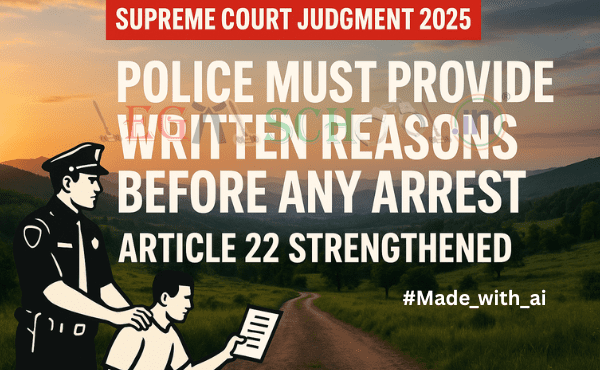
In a historic judgment safeguarding the fundamental right to personal liberty, the Supreme Court of India has ruled that no person can be arrested without the police first recording in writing the reasons for arrest.
The decision, delivered by a Bench of Chief Justice D.Y. Chandrachud and Justice J.B. Pardiwala, marks a major step toward ensuring transparency and accountability in the process of arrest. The Court clarified that this rule would apply to all categories of offences, including those under general laws and special statutes such as the UAPA (Unlawful Activities Prevention Act) and PMLA (Prevention of Money Laundering Act).
Background of the Case
The ruling came while hearing an appeal in the hit-and-run case involving Shrikant Tyagi, where the Court questioned the grounds and procedure of arrest.
The Bench observed that police officers frequently make arrests without adequate justification or written reasoning, violating the fundamental rights guaranteed under Article 21 (Right to Life and Personal Liberty) and Article 22(1) of the Constitution of India.
To ensure constitutional compliance, the Court emphasised that every arrest must be preceded by a written explanation, understandable to the person being detained.
Key Directions Issued by the Supreme Court
1. Written Reasons Mandatory Before Arrest
Before arresting any individual, police authorities must record in writing the specific grounds for arrest, using clear and understandable language.
A copy of this written note must be communicated to the person being arrested.
2. Application Across All Laws
This requirement applies to every type of offence, including those under special statutes like PMLA, UAPA, and other central or state laws where preventive or investigative powers exist.
3. Compliance with Article 22(1)
The ruling strengthens Article 22(1) of the Constitution, which grants arrested individuals the right to be informed of the reasons for arrest and the right to consult and be defended by a lawyer of their choice.
4. Magistrate’s Oversight
If an arresting officer fails to comply with this procedure, the Magistrate must treat the arrest as illegal and release the individual immediately. The Court warned that non-compliance will render the arrest invalid in law.
5. State and High Courts Informed
The Supreme Court directed that copies of the judgment be sent to all High Courts and State Governments, ensuring uniform application across the country.
Constitutional Significance
The Court interpreted Article 22(1) in light of individual liberty and the principle of natural justice, stating:
“Liberty is not a privilege granted by the State but a fundamental right that can only be restricted by just, fair, and reasonable procedure.”
This judgment reinforces earlier constitutional jurisprudence laid down in cases such as:
- DK Basu v. State of West Bengal (1997) – outlining arrest and detention safeguards
- Arnesh Kumar v. State of Bihar (2014) – discouraging arbitrary arrests in minor offences
- Maneka Gandhi v. Union of India (1978) – expanding Article 21 to include procedural fairness
Now, by requiring written grounds for arrest, the Supreme Court has created an additional procedural safeguard that strengthens citizens’ right to know and prevents abuse of police power.
Impact of the Judgment
This ruling will have far-reaching implications for law enforcement, judicial oversight, and human rights in India.
For Police:
- Police officials must document and justify arrests before detaining any person.
- Written reasons will be subject to judicial scrutiny during remand proceedings.
For Citizens:
- Individuals will have greater clarity about why they are being arrested.
- It enhances accountability and reduces the chances of arbitrary or politically motivated arrests.
For Judiciary:
- Magistrates are now required to verify written justifications at the time of first appearance.
- Any lapse will be deemed a violation of Article 22 and grounds for release.
Court’s Observation on Constitutional Spirit
The Bench emphasised that the right to personal liberty is a cornerstone of Indian democracy.
“Even one day of unlawful detention is too much. The Constitution requires both procedural and substantive fairness when a person’s liberty is curtailed.”
This statement reiterates that arrest is not the rule, but the exception, aligning with global human rights standards and the UN Declaration on Human Rights (Article 9).
Conclusion: Written Reasons Before Arrest
The Supreme Court’s judgment ensures that no arrest will be valid without written justification. This decision not only empowers individuals but also compels the police and investigative agencies to act with transparency and discipline.
By mandating written grounds before arrest, India takes another step toward protecting personal freedom and ensuring due process under the Constitution.